
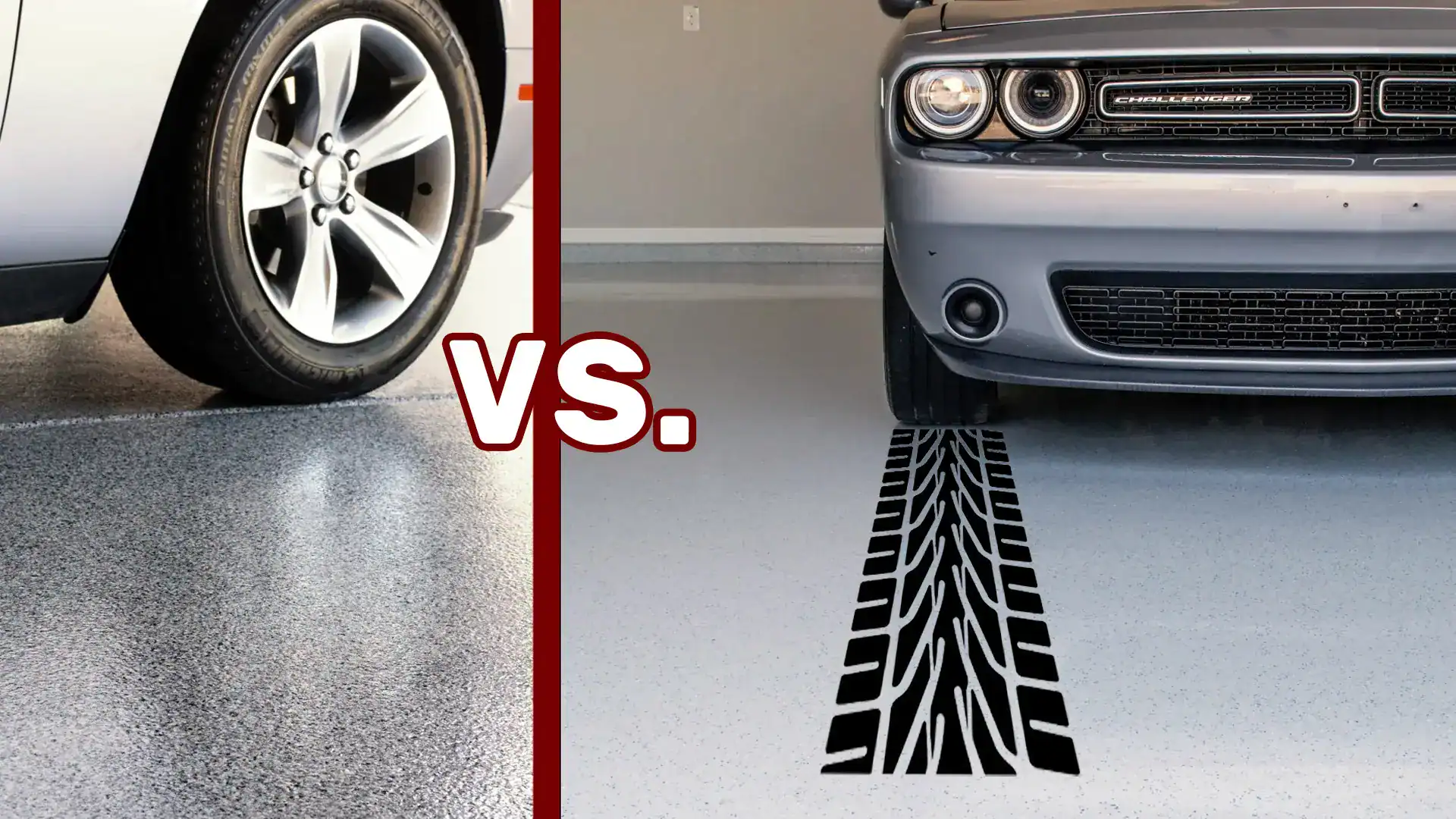
Hot tire transfer is one of the most common reasons garage floor coatings fail. Many homeowners do not think about it until they see dark marks, tacky spots, or peeling where their car sits. The reality is simple. Not all polyaspartic floor coatings are designed to handle it.
Myth: Hot Tire Transfer Only Happens on Very Hot Days
It does not take extreme heat to cause problems.
Try this. Feel your tires before you drive. Then check them again after a short trip. Even a quick drive generates enough friction to noticeably warm the surface.
Car tires contain plasticizers that keep the rubber flexible. As tires heat up, these softening agents migrate to the surface. Once parked, those plasticizers can transfer into the concrete below, leaving behind tread marks and discoloration. With lesser quality concrete coatings, the coatings may even begin to peel.
Myth: Any Polyaspartic Floor Coating Will Resist It
Many “1-day” systems use lower-quality polyurea-polyaspartic coatings that are not densely cross-linked (they often have 1:1 mixture ratios) and are less than 100%-solids. With “1-day” coating systems, these quick-cure polyurea-polyaspartic coatings are applied as both (a) the direct-to-concrete primer (bad idea), and (b) the single, clear top coat.
It is common knowledge that these coatings are poor direct-to-concrete primers. Why? Because they go down thinly and cure so quickly, especially in the presence of moisture, that they fail to deeply penetrate the concrete slab (i.e., they’re lousy moisture vapor barriers). They’re best used as color coats and clear top coats (not primer coats). But if they are low quality polyurea-polyaspartics, they can be problematic even as clear topcoats!
How do you assess the quality of a polyurea-polyaspartic? One way is to ask to see the Technical Data Sheet. Is it less than 100%-solids? Is it a 1:1 mixing ratio? If so, these polyaspartics tend to be far more vulnerable to hot tire transfer.
But the easiest way to tell is simply by looking at their warranty (specifically, the “Warranty Exclusions” section in your contract). Many of the “1-day” companies exclude hot tire transfer entirely or suggest using vehicle pads. That should raise a red flag! We suggest looking for another installer.
Reality: A 2-Day Polyaspartic Floor Coating System Makes the Difference
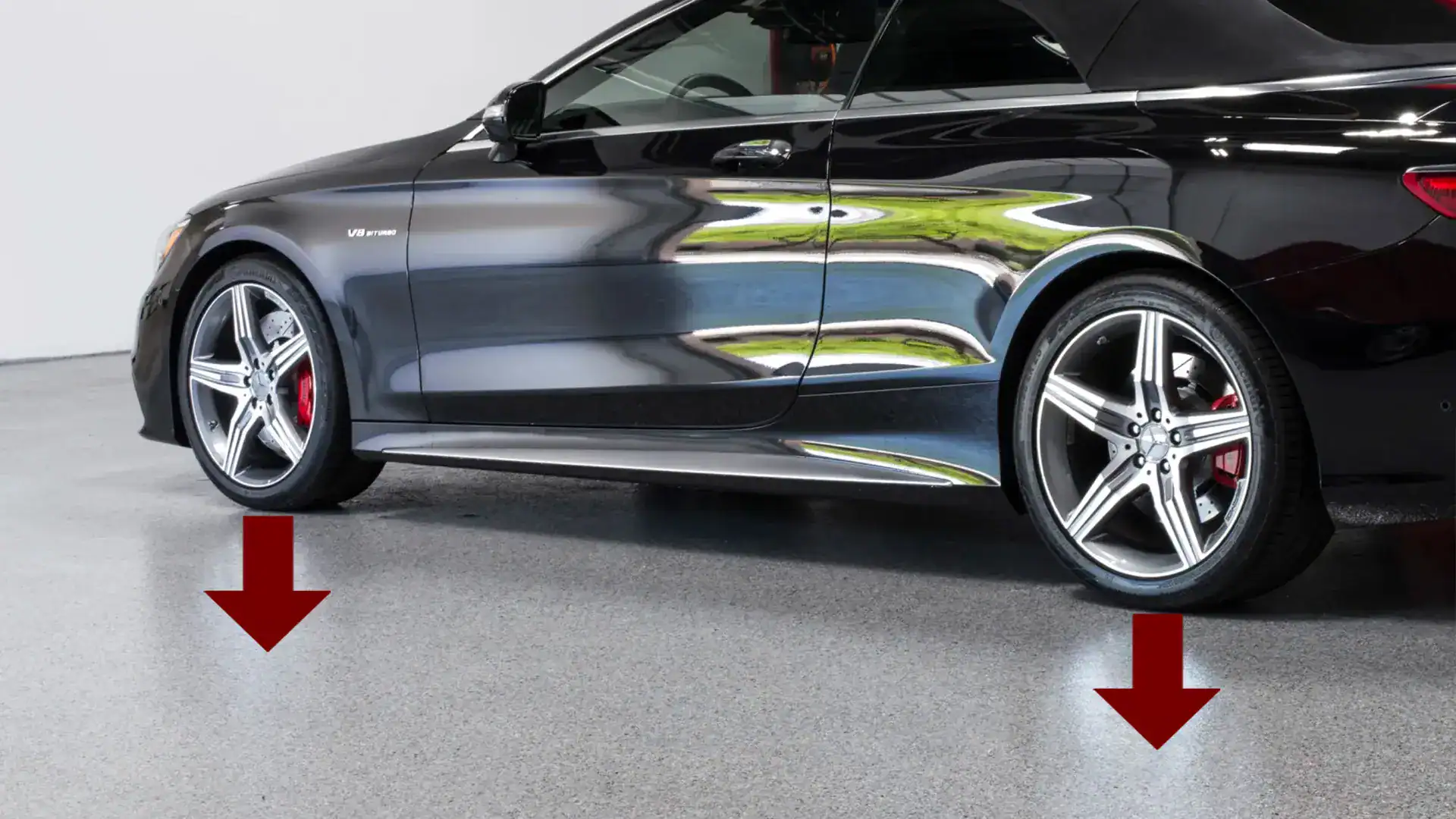
At Garage Floor Coatings of Maryland, we install hybrid epoxy and polyaspartic coating systems over a 2-day period. We use quality products, properly layered, to create the most durable coating system for long-term performance.
Day one includes mechanical grinding to open the concrete surface. Then, a high-build, moisture-mitigating, 100%-solids epoxy base coat is applied as the moisture vapor barrier. Into this thick base coat, we then broadcast the customer-chosen flake blend in a full-flake spread. The epoxy is allowed to cure overnight.
On Day two, we return to apply two separate (not just one!), highly cross-linking, 3:2 ratio, 100%-solids polyaspartic clear top coats. These dual layers create a dense, UV-stable surface that resists heat, pressure, chemical exposure…and hot tire transfer.
Reality: The Right System Stops Hot Tire Transfer
A properly installed garage floor coating prevents hot tire pickup, resists staining, and maintains its appearance over time.
In Maryland, where humidity and seasonal shifts can impact concrete, that level of protection matters.
Contact Garage Floor Coatings of Maryland today to learn more about a polyaspartic floor coating system designed to stop hot tire transfer before it starts.